01
Understand
Turn intent and constraints into a policy-aware plan.
TheOne · Official product
A governed AI operating system that gets to know how you work.
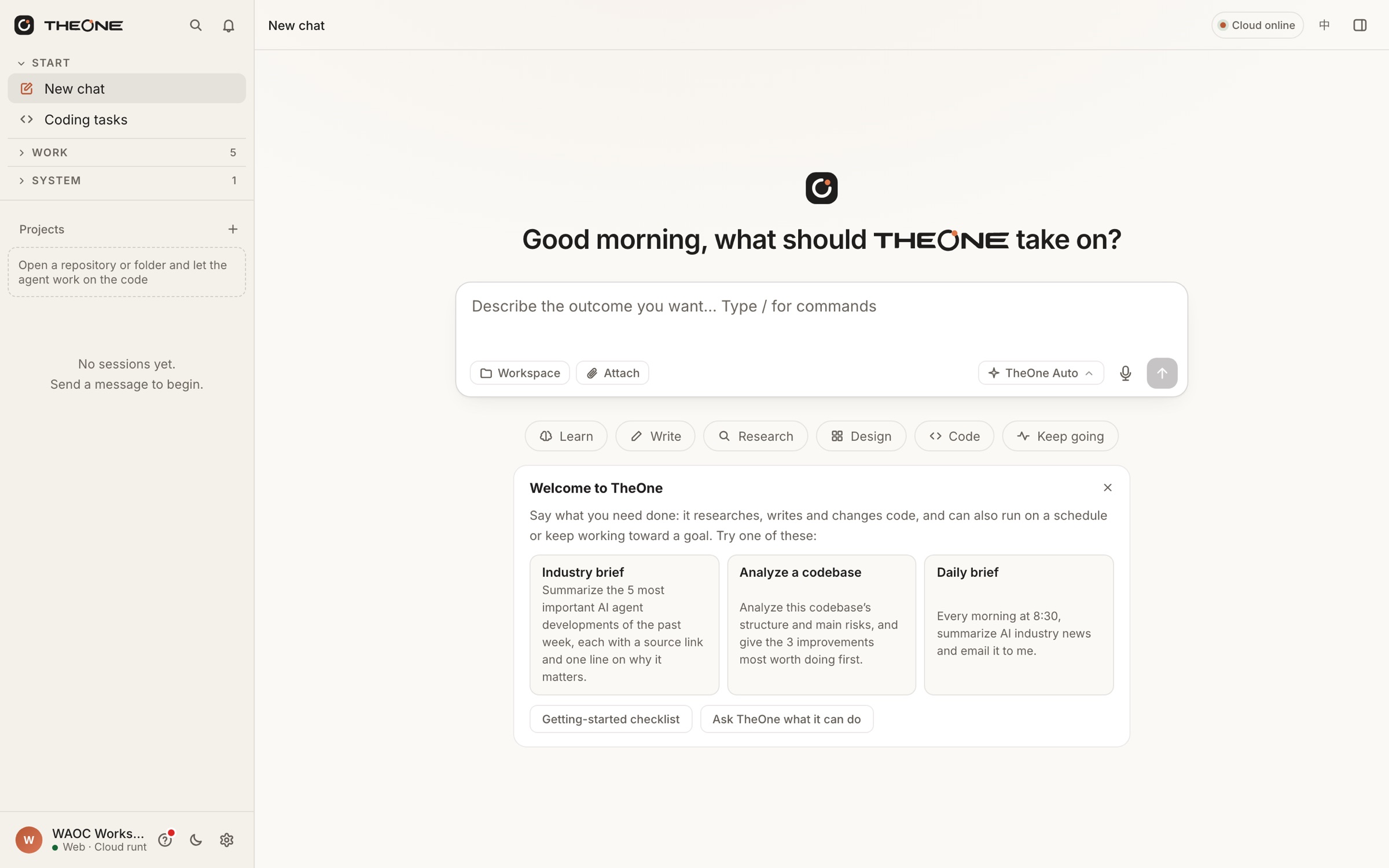
TheOne brings coding, research, documents, voice, goals and automations into one workspace. It learns only from verified outcomes, and every improvement still passes controlled release gates.
product areas
built-in skills
automation templates
delivery channels
coding engine paths
Product-code snapshot verified 29 October 2026. Engine and channel availability depends on workspace configuration.
What it does
The product website goes deeper on every area. This company page keeps the map short and sends you to the source.
From repository analysis to a tested, reviewable change.
Talk naturally while approvals stay visible on screen.
Sourced briefs, comparisons and finished writing.
Real Word, PDF, PowerPoint, SVG and prototype deliverables.
Scheduled and event-driven work that keeps moving.
Preferences, facts and lessons you can inspect and edit.
93 built-in ways of doing real work well.
Governed runs from your tools, agents and systems.
Research, risk and simulation — never live brokerage.
Failures become candidates, then evaluation, canary and rollback.
Not another chatbot
TheOne does not aim to be another chatbot, workflow builder or automation tool — those are capabilities it can use, not what it is. Its identity is a persistent root intelligence: it keeps its own state, memory, goals and responsibility chain across sessions, so closing the window does not reset what it was doing or what it has learned.
“A governed, verifiable and persistent intelligence that understands human intent, acts across digital and physical systems, learns from verified outcomes, and improves only through controlled release gates.”
How it works
TheOne can carry work forward, but action, accepted evidence and product improvement remain separate decisions.
01
Turn intent and constraints into a policy-aware plan.
02
Coordinate intelligence, skills and approved execution.
03
Check the outcome against proof, cost and quality.
04
Keep only verified outcomes as reusable experience.
05
Evaluate candidates before canary, promotion or rollback.
Inside the OneAI platform
The boundary matters: one product does not silently become the model provider, executor, scheduler, evidence store and release authority.
Governs intent, coordination, authority, proof and memory.
Provides intelligence access and model routing.
Keeps missions and task state durable.
Executes approved tools and computer actions.
Supplies scoped context and preserves shared evidence.
Evaluates, promotes and rolls back capability releases.
For technical readers
Open the sections below for the seven-layer model and the L1–L6 maturity ladder. They explain how the product is built without replacing the product website.
Understanding, reasoning, decisions, delegation, reflection and adaptation.
Identity, state, runs, policy, approval, budget, permission, scheduling and recovery.
Model routing, planning, reasoning and capability awareness.
Context, episodic and semantic memory, and governed experience.
Skills, sub-agents, durable work and approved external execution.
Independent verification, artifacts, receipts, evidence and audit.
Failure mining, candidates, benchmark, canary, promotion and rollback.
Conversation and model calls.
Tool use and an agent loop.
Durable runtime, memory, policy and verification.
Governed experience, self model and independent verification.
Governed candidates across skills, strategy, prompts and models.
Dynamic multi-agent, long-horizon enterprise operation.
Claimed today: the connected L4 learning foundation and its governance boundaries. Not claimed: autonomous self-evolution, unsupervised production promotion, or an independently proven L5 system.
Current engineering focus
Every entry point — chat, automation, event, API, coding and multi-agent — resolves into the same governed run. Verified outcomes may become experience; candidate improvements still pass evaluation, approval, canary and rollback gates.
Strict run state machine — illegal transitions like completed → executing are rejected by default.
Immutable run events — the full, tamper-evident history behind every run, not a mutable log field.
Run-bound approval — a grant is checked against tenant, user, run, action and policy version, and cannot be reused by another task.
Full checkpoint contract — state, plan, tool state, budget, pending approvals and artifacts, so a run survives a restart or a deploy.
Unified entry points — automation, webhook, API and chat all create the same run and hand it to the same kernel.
Governed experience — only verified outcomes can become reusable experience, linked back to their evidence.
Controlled evolution — candidates are evaluated against a baseline, approved, canaried, monitored and reversible.
The product now has its own home
Use OneAI Labs for the company and platform context. Use the1os.io for product capabilities, downloads and the app.